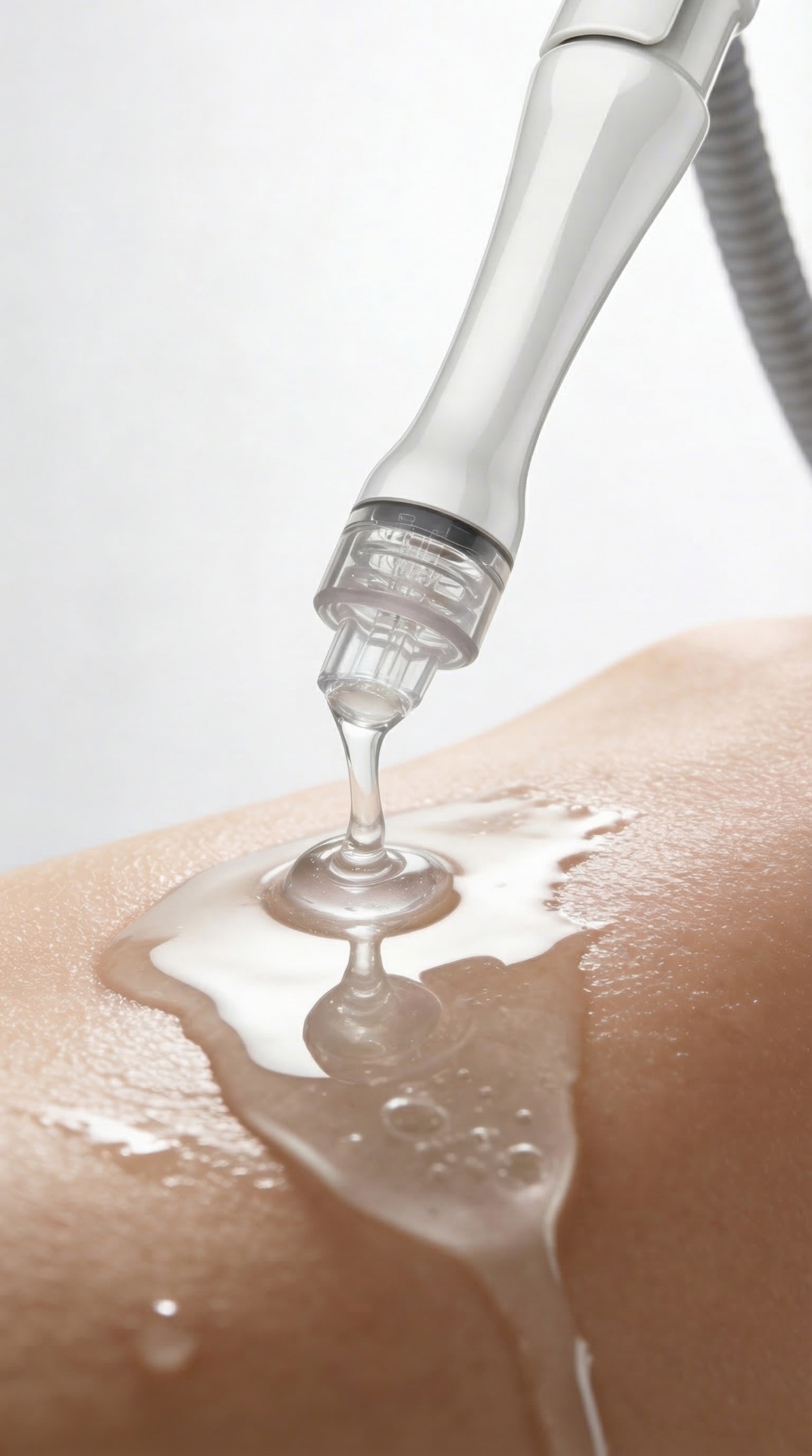
Mesotherapy, Reconsidered
Mesotherapy has always rested on a single, seductive idea: that the most effective place for an active ingredient is exactly where the skin needs it. The execution is finally catching up to the ambition.
Mesotherapy has always rested on a single, seductive idea — that the most effective place for an active ingredient is not on the surface of the skin but inside it, delivered precisely to the layer where it can do its work. For years the idea outran the execution. The technique was associated with a certain excess: many injections, much product, results that depended heavily on the hand holding the needle. What is happening now is a quiet reconsideration of the whole premise.
The reconsideration begins with restraint. The modern view treats the dermis less as a reservoir to be filled than as a system to be signalled. Smaller quantities of well-chosen actives — hyaluronic acid, peptides, antioxidants, the messengers of cellular communication — placed accurately can outperform larger volumes scattered without precision. The goal shifts from saturation to conversation. The skin is not being loaded; it is being instructed.
This changes how practitioners think about formulation. An active delivered into the dermis behaves differently from the same molecule sitting on top of it. Stability matters more, because the ingredient must survive the journey intact. Molecular size matters, because it determines how freely a compound moves through tissue. Increasingly, the serums designed for these protocols are engineered for the trip itself — protected until they reach the skin, then released where absorption actually happens. The formula and the method are being designed together rather than in isolation.
The second reconsideration concerns comfort. The old mesotherapy asked clients to trade discomfort and downtime for results, and many quietly declined. The newer approaches lower that toll. Finer instruments, gentler energy, and smarter delivery reduce the trauma of the procedure without surrendering its depth. A treatment that once felt clinical now sits closer to skin care — something a client can fold into ordinary life rather than schedule around.
The third reconsideration is evidential. Mesotherapy historically suffered from a gap between testimonial and proof. The serious end of the field is closing it, measuring outcomes the way the rest of aesthetic medicine has learned to: hydration that persists at twenty-four hours, measurable gains in elasticity, visible refinement of texture across a defined number of sessions. When results can be observed rather than merely claimed, a technique earns a different kind of trust.
What emerges from all this is not a rejection of mesotherapy but its maturation. The principle was always sound; what it lacked was discipline. Precision in placement, intelligence in formulation, restraint in volume, honesty in measurement — these are the qualities turning an old idea into a modern one.
The most interesting treatments rarely announce themselves loudly. Mesotherapy, reconsidered, is a study in quiet accuracy — the belief that beauty is less about how much you deliver than about how exactly you deliver it.
References
- Sivagnanam G. Mesotherapy - the french connection. Journal of Pharmacology and Pharmacotherapeutics, 2010.
- Amin SP, et al. Mesotherapy: a review. Dermatologic Surgery, 2006.
- El-Domyati M, et al. Mesotherapy for skin rejuvenation: a histological evaluation. Journal of Cosmetic Dermatology, 2019.
- Iorizzo M, et al. Mesotherapy in dermatology. Clinics in Dermatology, 2008.